I'm thinking of such a list because of that new song "Put It Down" by Brandy featuring Chris Brown. I think Brandy
was better when she was up-and-coming in the '90s with "I Wanna Be Down" (geez, how many Brandy songs have the word "down"????) and "Baby". Her song with Kanye back in '04 "Talk About Our Love"
is mediocre. The aforementioned singles are the only Brandy songs I'd
ever keep in my mp3 player. Oh yeah, the talentless hack Ray J (with a
terrible singing voice and star of the Kim Kardashian sex tape) is her
younger brother (Ray J's real name is William Ray Norwood Jr.).
So I've decided as a new year comes and hip hop progressively gets worse (but at least the fact that Kendrick Lamar's new album Good Kid, MAAD City has outsold 2 Chainz' Based on a TRU Story I have hope...and the new GOOD Music compilation Cruel Summer is also pushing 100k's of units) I wonder how many rappers or R&B singers who were in their prime in the '90s are just stale in the new millennium?
- Usher: I like "You Make Me Wanna" and "Nice & Slow" from his breakout 1997 album My Way. And I just now discovered his debut single recorded when he was just 13, "Call Me a Mack" (from the soundtrack of the 1993 film that starred Tupac and Janet Jackson, Poetic Justice). In his '90s songs, Usher even rapped verses! 8701 (2001) was alright, Confessions
(2004) was way overplayed in its time and was a step downward because now I
think "Burn" is essentially "U Got It Bad" with more RPM. "Caught Up" is better though.
Oh, one time I was listening to Detroit's hip hop/R&B station WJLB
on iHeartRadio (another sign I need to go back to Michigan, haven't been there since May 1997) and heard Maxwell's "Fortunate" and that was the first
time in my life I realized that "U Got It Bad" interpolated the chorus
of "Fortunate". Nowadays Usher always puts out party music as singles, like "Love In This Club" [2008] with a beat ripped off of GarageBand software! Then he hopped on the Auto-Tune bandwagon in 2010 with "OMG" featuring will.i.am and did a super poppy club anthem "DJ Got Us Falling in Love" with Pitbull (a rapper who's a traitor to his genre, but that's a whole 'nother story). And "Hey Daddy (Daddy's Home)" went far on the raunchy side especially with annoying rapper Plies. I'm not too fond of "What Happened to U", ESPECIALLY since if you were listening to radio the beginning fools you into thinking you're hearing "One More Chance" by the Notorious BIG! "Hot Tottie" (2010) rips
off the beat of Jay-Z's "On to the Next One". Usher has had a HUGE creativity issue for the past several years.
- Members of the Wu-Tang Clan: 8 Diagrams (2007) was one hell of a generic album...nothing that Wu-Tang or its members does in the future will ever KO Enter the Wu-Tang (36 Chambers) (1993), Wu-Tang Forever (1997), Method Man's Tical (1995), Raekwon's Only Built 4 Cuban Linx (1995), etc.
- Fat Joe: I can listen to his 90s songs like "The Shit Is Real", "John Blaze", "Flow Joe", "Watch Out", or his parts in songs like
"Twinz (Deep Cover '98)" on repeat especially with the heavy, deep, street lyrics and flow with genuine hip hop beats. However, Fat Joe became way too
commercial and generic after J.O.S.E. in 2001 especially with
getting pop-&-B singers like R. Kelly and Ashanti singing hooks.
From that album "My Lifestyle" is a hard track, but "We Thuggin'" is
just guilty pleasure even though hearing that song on KMEL back in
October 2001 helped me get into hip hop when I was younger. "What's Luv?" wears out as well. Loyalty (2002) was a very low creative point before Fat Joe returned in 2004 for the second Terror Squad album True Story with number-one hit "Lean Back". He went solo again All or Nothing (2005), the lead
single featuring Nelly "Get It Poppin" is wack but the album had other
harder tracks like "So Much More" or the anti-50 Cent song "My Fofo". Me Myself & I
(2006) marked the time when Fat Joe abandoned his NYC roots for the
trendy Southern sound in "Make It Rain" featuring Lil Wayne and then
doing guest performances on DJ Khaled's album. Even the deeper cuts like "Damn" and "The Profit" were getting more dull. The Elephant in the Room (2008) = rock bottom. I was never into "I Won't Tell", which sounded more like POP MUSIC than
hip hop (especially since pop-&-B J. Holiday sang). Even the deeper
cuts like "K.A.R" and "The Fugitive" were getting generic and tiresome. And look what the hell Fat Joe is doing now with super-lame party music like "Another Round" with Chris Brown (tell me again WHY he still gets prominent spots after beating Rihanna?) and not even "Pride N Joy" featuring Kanye and a bunch of others like Jadakiss and Mos Def is worth listening. "Instagram That Hoe"? By the title itself that's straight garbage. Fat Joe has been using the same old same old formula for theme and rapping for nearly 7 years now. How many songs about hot women, the club, and luxuries can he do creatively anymore? At age 42 maybe he should think about doing less music.
- Master P or any other artist signed with No Limit Records:
I remember hearing "We Like Them Girls" by Silkk the Shocker on the
radio in 2004 (when I was in 8th grade and basically liking pretty much any crap I heard on Wild 94.9 or 106 KMEL). At that time I'd also discovered "Make Em Say Uhh" by
Master P on the compilation album MTV the First 1000 Years: Hip Hop & then thru sites like MSN Music and Amazon.com the other No Limit rappers and other songs they did in
the late '90s such as: "Bout It Bout It" by Master P and "I Got the Hook Up" by MP. Thinking back on it, there's a reason why Master P and
the other No Limit rappers ended up on Koch Records (which later became
E1 Music). I mean, how is Master P's "Them Jeans" (2004) any different from Lil Jon's "Get Low" (2002)?
- Lil Wayne: A rapper since 1993 (when he was just 11), Wayne found his big break in 2008 with Tha Carter III. Sadly in order to achieve such a high-sales album with many Grammys and top singles Wayne abandoned his gangsta rap sound from his earlier career for a more mainstream (and of course the dreaded AUTO TUNE) sound. Examples of Wayne's earlier stuff from Cash Money Records: "The Block Is Hot" (1999), or go to 0:55 for his part in B.G.'s "Bling Bling" (1999), or 1:00 for his verse in "From Tha 13th to Tha 17th" when he was known as "Baby D" in rap duo The B.G.'z back in 1995 (when Wayne was only 13), or 3:20 at "I Need a Hot Girl" (with his group Hot Boys in 1999). In 2004 Wayne's rapping style became softer and more structured, like in "Bring It Back" and "Go DJ" (both '04) and "Fireman" and "Hustler Musik" (2005). Wayne's career took an interesting turn in 2006. That year he did just mixtapes and guest performances: both on the poppier side ("You" by Lloyd, "Make It Rain" by Fat Joe, the remix of "Gimme That" by Chris Brown) and on the street side (like the anti-George W. Bush mixtape cut "Georgia Bush"). And then in 2007 came The Leak EP with such underground tracks like "I'm Me". Unfortunately in 2008 when I first heard "Lollipop" on the radio with all the auto tune I knew Lil Wayne went beyond selling out. Things only got worse with his fake "rock" album Rebirth in 2009 (STILL with that auto tune), Wayne putting Drake in the spotlight, and the very boring album I Am Not a Human Being in 2010. These days Lil Wayne is doing far more lame pop music like "How To Love", "Right Above It", or "Mrs. Officer" than tracks where he actually cares about rapping like in "John" or "6 Foot 7 Foot".
- Members of A Tribe Called Quest: Tribe was VERY great when they were together in the 90s. However the solo stuff that Tribe members put out isn't very memorable. "Gettin' Up" by Q-Tip was better than any of the mainstream hip hop overplayed on radio back in '08. But does that stand up to Tribe classics like "Scenario", "Buggin' Out", "I Left My Wallet in El Segundo"? NO!
- R. Kelly: Transformed from slow jam soul singer in the early 90s ("Bump n Grind") to mainstream urban contemporary singer in the late 90s ("Home Alone") to straight up baller in the 00s and beyond (his many many guests spots/collabos with rappers). Oh, don't forget that child porn trial too. R. Kelly's attempt at being everything to every audience gave him a whole bunch of repetitive uncreative stereotypical mainstream rap songs..."Supaman High", "That's That", the Jay-Z collaboration albums. "Playas Only", etc.
Any others? Comment below.
Showing posts with label The Notorious B.I.G.. Show all posts
Showing posts with label The Notorious B.I.G.. Show all posts
31 December 2012


13 July 2010
Shuffle degrees of separation
On my way home today on the bus I was listening to my Sansa e250 MP3 player on shuffle. These songs all have some sort of genre/generational organisation. Tags for categories follow titles.
- Snoop Dogg featuring Dr. Dre and D'Angelo: "Imagine" (Tha Blue Carpet Treatment, 2006) *2000s
- In Flames: "Leeches" (Come Clarity, 2006) *2000s, international (Sweden)
- The Beatles: "The Fool on the Hill" (Magical Mystery Tour, 1967) *1960s, oldies, international (UK)
- The Doors: "Touch Me" (The Soft Parade, 1969) *1960s, oldies, West Coast
- Game featuring 50 Cent: "Westside Story" (The Documentary, 2005) *2000s hip hop
- Jay-Z featuring Alicia Keys: "Empire State of Mind" (The Blueprint 3, 2009) *2000s hip hop
- Rage Against the Machine: "Freedom" (Rage Against the Machine, 1992) *1990s alternative rock, hip hop, West Coast
- Alice in Chains: "Heaven Beside You" (MTV Unplugged, 1996; originally from Alice in Chains, 1995) *1990s alternative rock, West Coast
- Pink Floyd: "Shine on You Crazy Diamond" (Wish You Were Here, 1975) *rock
- Fat Joe: "Success (DJ Premier remix)" (Jealous One's Envy, 1995) *1990s hip hop, East Coast
- The Notorious B.I.G.: "Big Poppa" (Ready to Die, 1994) *1990s hip hop, East Coast
- She & Him: "Change Is Hard" (Volume One, 2008) *2000s, alt/indie, female vocalist
- Duffy: "Mercy" (Rockferry, 2008) *2000s, alt/indie, female vocalist, international (UK)
- The Guess Who: "No Time" (American Woman, 1970) *oldies, international (Canada)
- The Beatles: "Penny Lane" (Magical Mystery Tour, 1967) *oldies, international (UK)
- Death Cab for Cutie: "I Will Follow You Into the Dark" (Plans, 2005) *alt/indie
- Rage Against the Machine: "Know Your Enemy" (Rage Against the Machine, 1992) *alt/indie
- The Jimi Hendrix Experience: "All Along the Watchtower" (Electric Ladyland, 1968) *oldies
- Mos Def: "Beef" (Rawkus Records: Best of Decade I 1995-2005, 2005) *2000s, hip hop
- Lamb of God: "Laid to Rest" (Ashes in the Wake, 2003) *2000s, metal
- Snoop Dogg featuring Dr. Dre and D'Angelo: "Imagine" (Tha Blue Carpet Treatment, 2006) *2000s
- In Flames: "Leeches" (Come Clarity, 2006) *2000s, international (Sweden)
- The Beatles: "The Fool on the Hill" (Magical Mystery Tour, 1967) *1960s, oldies, international (UK)
- The Doors: "Touch Me" (The Soft Parade, 1969) *1960s, oldies, West Coast
- Game featuring 50 Cent: "Westside Story" (The Documentary, 2005) *2000s hip hop
- Jay-Z featuring Alicia Keys: "Empire State of Mind" (The Blueprint 3, 2009) *2000s hip hop
- Rage Against the Machine: "Freedom" (Rage Against the Machine, 1992) *1990s alternative rock, hip hop, West Coast
- Alice in Chains: "Heaven Beside You" (MTV Unplugged, 1996; originally from Alice in Chains, 1995) *1990s alternative rock, West Coast
- Pink Floyd: "Shine on You Crazy Diamond" (Wish You Were Here, 1975) *rock
- Fat Joe: "Success (DJ Premier remix)" (Jealous One's Envy, 1995) *1990s hip hop, East Coast
- The Notorious B.I.G.: "Big Poppa" (Ready to Die, 1994) *1990s hip hop, East Coast
- She & Him: "Change Is Hard" (Volume One, 2008) *2000s, alt/indie, female vocalist
- Duffy: "Mercy" (Rockferry, 2008) *2000s, alt/indie, female vocalist, international (UK)
- The Guess Who: "No Time" (American Woman, 1970) *oldies, international (Canada)
- The Beatles: "Penny Lane" (Magical Mystery Tour, 1967) *oldies, international (UK)
- Death Cab for Cutie: "I Will Follow You Into the Dark" (Plans, 2005) *alt/indie
- Rage Against the Machine: "Know Your Enemy" (Rage Against the Machine, 1992) *alt/indie
- The Jimi Hendrix Experience: "All Along the Watchtower" (Electric Ladyland, 1968) *oldies
- Mos Def: "Beef" (Rawkus Records: Best of Decade I 1995-2005, 2005) *2000s, hip hop
- Lamb of God: "Laid to Rest" (Ashes in the Wake, 2003) *2000s, metal
03 August 2009
Movie review: "Notorious" (2009)
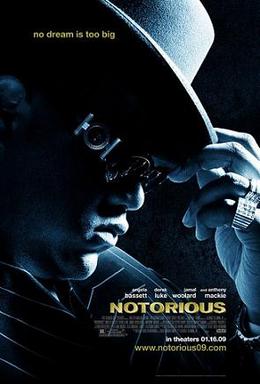
On Sunday night, I watched a Netflix-rented DVD of the 2009 film Notorious, which was originally released to theaters on Jan. 16 this year and on DVD on April 21. This is a biopic of the life of rapper The Notorious B.I.G. (born Christopher George Latore Wallace), who was murdered in March 1997 at the age of 24. To this day, his murder is still unsolved. The movie focuses mostly on Biggie's music career; the first quarter of the film centers on his childhood and high school years.
Of course, because we all know that The Notorious B.I.G. is no longer with us, the movie opens with the "ending"...with a scene where B.I.G. exits a Los Angeles party that fateful late night of March 8, 1997. Shortly after midnight, he is shot dead. Then the movie flashes back to Biggie's childhood. This effect is similar to the episode structure of the CBS/CTV police drama Flashpoint.
Biggie's son, Christopher Jordan (CJ) Wallace, plays a young Christopher Wallace before he was B.I.G. Even as a student at a Catholic middle school, the young Chris knew about the hip-hop sound. He and a friend are rapping to Kurtis Blow's "The Breaks" at the schoolyard. At home, young Chris's mother Voletta Wallace (played by Angela Lansbury) introduces Chris to his father, George Latore, who had been absent from Chris's life since Chris was a toddler. Voletta and George get into an argument while Chris is upstairs in his bedroom. George storms out of the Wallaces' apartment. Volette tells Chris that his father will never come back again.
As Chris enters high school (according to Wikipedia, after graduating from middle school he attended a magnet school), he gets involved in the 1980s crack epidemic. Rapper Jamal "Gravy" Woolard plays a maturing Chris. In one scene, the high school-age Chris hides a plate of crack cocaine under his bed as he hears his mother coming. Because of the drugs and the street life in general, Chris loses his "good boy" status, as he exhibits during an algebra class one day as he insults his teacher during class. The teacher evicts Chris from the classroom, so Chris goes out to the city to socialize with his fellow gangsters the rest of the day. Chris comes home with a "corny" (in his opinion) country music record for his mother in the hopes of making her happy, but an angry Voletta raises up a letter from Chris's school stating that Chris missed 20 days in one month. Chris argues that he'd been attending school for three consecutive weeks. Then, Voletta angrily asks why she came all the way to the U.S. from Jamaica, only to have raised a bad son. Next, she alleges that Chris hid mashed potatoes under his bed, but Chris admitted that he'd been involved in the local drug trade. Chris's mother throws him out of home.
With all the freedom a bad boy could ask for, Chris gets deeper in the street culture of Brooklyn. He is shown winning a freestyle rap battle, with his playful rhymes, stable flow, and craftful grasp of language evoking cheers from the crowd. But being involved in the less desirable side of life makes him face the music. At home, Voletta is looking over paperwork when she gets a "collect call" from her son out of the county jail. Voletta sternly tells her son to take responsibility for himself. While incarcerated, Chris thinks over all the bad things he's encountered in life and converts them into poetry. He jots down rhymes and ideas in a composition book.
After getting out of jail, Voletta hugs Chris for a warm welcome home, and Chris meets his baby daughter, T'yanna (Taylor Dior), who was born by his girlfriend Jan (Julia Pace Mitchell). To support his new daughter, Chris finds a way to make a living: rapping. With friends Damion "D-Roc" Butler (Dennis White) and Jason "Lil' Cease" Lloyd (Marc John Jeffries), Chris records a demo tape, "Microphone Murderer". Chris then meets producer Sean "Puffy" Combs (Derek Luke) from Uptown Records. Combs seems hostile to Chris's lifestyle: Combs would sign Chris only if Chris gave up drug dealing. Chris disobeys; he and D-Roc go out to the street again. Chris sells a man crack vials that he hid in his mouth; however, an unmarked police vehicle blasts its sirens and takes the duo by surprise. The plainclothes police officers chase Chris and D-Roc down the street and into an alley and take them into custody. Chris tries to discard his illegal gun, but the police find it anyway. Because he wants and believes that Chris can succeed as a rapper, D-Roc takes the blame for the gun and crack. D-Roc knows well that Chris could be locked up for nearly a decade for this.
More disadvantages come for Chris's life: Uptown lays off Combs, and Chris's mother has breast cancer. Chris suffers from depression until Combs establishes his own label Bad Boy Records. Chris begins performing as "The Notorious B.I.G.". He makes his debut at the 1992 Howard University Homecoming concert. The crowd appreciates his song "Party and Bullshit", but for some reason a fight breaks out on stage. Luckily, Biggie's rhymes save the crowd from erupting into a riot. He then begins recording his debut album Ready to Die, to be released in 1994. Combs and other producers criticize him for being "too street" and assert that the record will tank if the mainstream can't handle it. This leads to Biggie recording "Juicy", which samples old-school R&B single "Juicy Fruit" by Mtume. While recording Ready to Die, Biggie meets Kimberly Jones, the rapper known as Lil' Kim and played here by former 3LW singer Naturi Naughton. He ends up having a relationship with Kim but dislikes her style of rapping. Tensions between the two rappers lead to Biggie assaulting Kim in studio.
Ready to Die becomes a bestselling album, and the movie shifts into a slideshow of various images of Biggie's success. In August 1994, Biggie marries singer Faith Evans while ignoring Jan and T'yanna in the process. Tensions arise when Jan calls Faith, who confronts Biggie in a hotel. Another woman was in the room, and the two women get in a catfight. Faith and Biggie reconcile despite the incident.
It's 1995, the year after Ready to Die was released. The tides turn against Biggie's favor, as the East Coast/West Coast rap rivalry has begun. Initially, Biggie befriended West Coast rapper Tupac Shakur (Anthony Mackie). However, Tupac gets shot in a recording studio and blames Biggie and crew. At the Source Awards ceremony that year, Suge (pronounced "shoog") Knight, CEO of Tupac's label Death Row Records, makes a speech dising Bad Boy Records. This sentiment has spread nationwide; the movie cuts from the regular plot to showcase various news reports and "citizen on the street" interviews where average hip-hop fans takes sides and obscenely defame the East or West coasts. Back in the regular plot, Biggie takes the stage one time with the audience booing him, and some people get into fights in the stands. However, they cheer his new track, "Who Shot Ya?" (released on Biggie's 1999 posthumous Born Again and 2006 remaster of Ready to Die). Tupac responds harshly to that track with his own "Hit 'Em Up" (a B-side to the "How Do U Want It" single; the track was released to Pac's posthumous Greatest Hits CD). Then the media gets involved with this mess with a smear of its own. A friend of Big's shows Biggie a magazine cover with Tupac and Faith Evans together. In yet another allegation of infidelty (this time on Faith's part), Biggie confronts Faith, only to realize it was indeed the magazine's fault. Tupac is shot dead in Las Vegas on September 13, 1996. Biggie and his mother talk about it. To deal with his ongoing woman issues, Biggie and Faith visit Jan and T'yanna; during the visit, Biggie teaches T'yanna to be strong and never let a man call her a bitch.
Despite his mother's warning, Biggie goes to Los Angeles to promote his latest effort, Life After Death. After the promo party, Biggie and crew ride to the hotel. At a stoplight, Biggie's life ends when a gang member from a neighboring Chevy Impala shoots Biggie four times. The crowd of fans who came to greet Biggie scatter around the sidewalks like crazy. Biggie's crew rushes him to the hospital, but it's too late. Biggie's funeral is held, and during the funeral procession, fans mourn and celebrate his music. Life After Death was released on March 22, 1997, two weeks after Biggie's death.
Despite a budget only half of that of the Eminem biopic 8 Mile (Notorious ~ $20 million; 8 Mile ~ $41 million), Notorious still effectively narrates the short yet powerful life of The Notorious B.I.G. from childhood to rap star to death. Jamal Woodward applies his background as a mixtape rapper to portray one of the most talented MC's to have graced the music industry. The film also depicts the street culture articulately and realistically, especially in one instance where Biggie's friends encourage him to be beyond the "mixtape rapper" and the NYPD's unmarked patrol vehicle that caught Biggie and D-Roc in the act. For anyone who's dissatisified over the East Coast/West Coast beef, the film puts it out for what it really was: nothing but a media-hyped smear campaign, not really a measure of MC talent.
In this era where hip-hop has shifted from the streets to the dance floors and nightclubs, when "crunk"/"snap music" nonsense like "Crank That (Soulja Boy)" and "Stanky Legg" dominate the airwaves, cable music video networks, and YouTube, is it any wonder why this film made a mere $36 million in the U.S. beyond its January not summer release? And there were critics who derided this film as "Biggie's Wikipedia page reformatted for the big screen" and "half pop fable, half naturalistic docudrama". Overall, critical views were mixed.
Director: George Tillman, Jr.
Writers: Reggie Rock Bythewood, Cheo Hodari Coker
Rated: R (profanity, sexual dialogue, nudity, drugs)
Run time: 2 hours, 2 mins. (theater version); 2 hours, 8 mins (director's cut, which I watched)
Subscribe to:
Posts (Atom)